

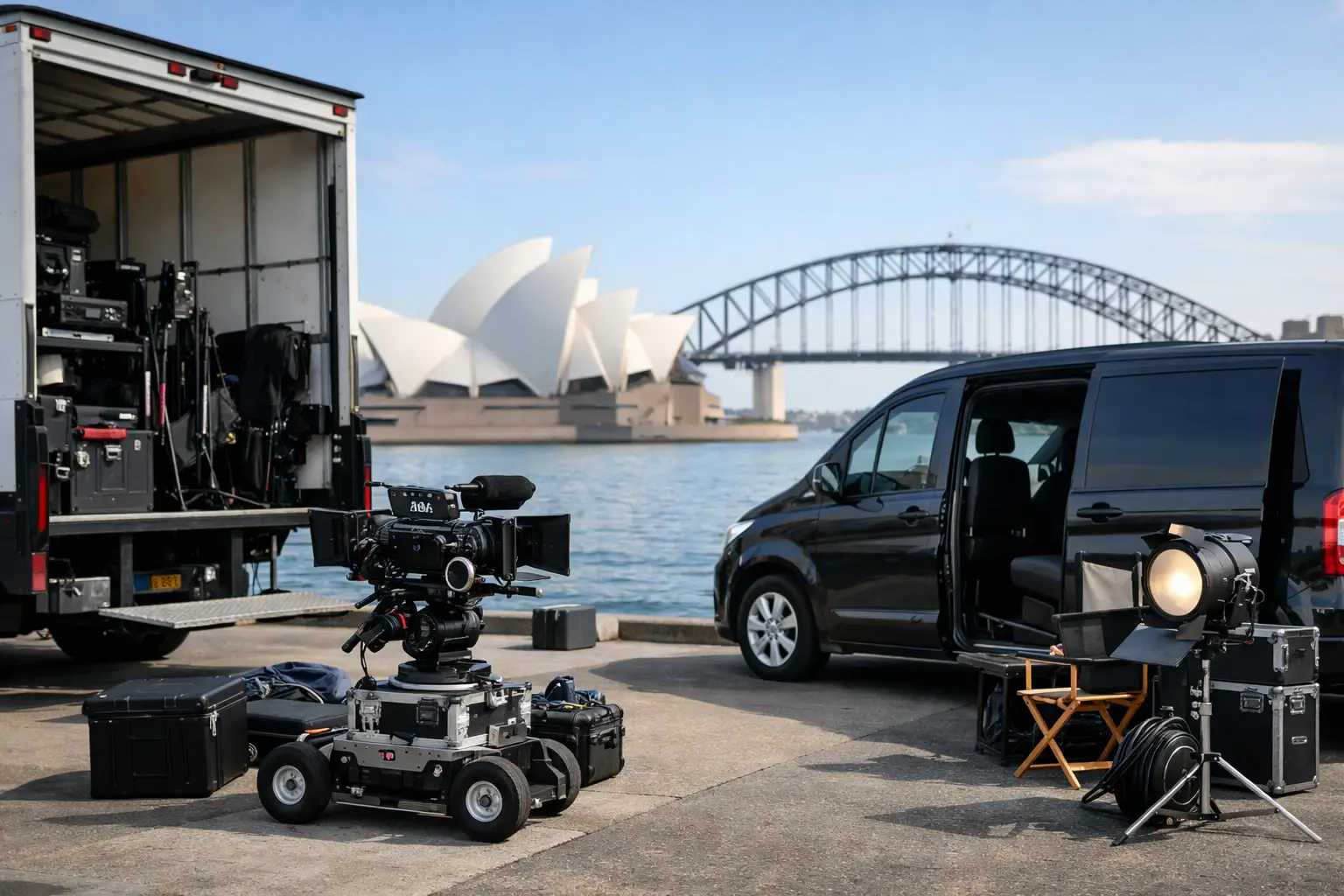
A call time that slips by 20 minutes can throw off an entire shooting day. When cast, crew and support staff are moving between studios, streets, locations and accommodation, film production transport Sydney teams depend on needs to be punctual, flexible and carefully planned from the start.
Why transport matters on a production day
Transport is rarely the headline item in a production schedule, but it affects almost everything else. If the hair and makeup team arrives late, the first shot moves. If background talent is split across multiple cars with inconsistent pickup times, check-in becomes messy. If crew are left waiting at wrap for return transfers, fatigue becomes part of the next day’s problem.
That is why production transport should be treated as an operational function, not an afterthought. Reliable group transport keeps people where they need to be, when they need to be there, without asking your production team to spend the day chasing drivers, rearranging seat allocations or fixing missed pickups.
For productions working across Sydney, that challenge can become even more complex. Different call times, traffic conditions, unit moves and access restrictions mean a simple transfer on paper can be much harder in practice. An experienced charter provider helps reduce that pressure by planning around the realities of the day, not just the booking form.
What good film production transport in Sydney looks like
The right transport setup is not always the biggest vehicle or the most complicated plan. It is the one that suits the movement of your production.
Some jobs need a luxury coach for crew transfers from a central hotel to set. Others need minibuses running in staggered waves across the day. A larger production may need separate movements for cast, crew, extras and support staff so arrival times match production priorities. There are also occasions where one vehicle handles a fixed shuttle route while another is reserved for flexible standby work.
Good planning starts with basic but essential questions. How many passengers are moving at each stage? Are there split call times? Is the pickup point easy for a coach to access? Will the unit wrap at one location and bump out at another? Are there likely delays due to road closures, event traffic or permit conditions?
When those details are considered early, transport becomes easier to manage and easier to trust.
Crew transfers need consistency
Crew transport usually works best when it is predictable. Drivers arrive on time, pickup points are clearly confirmed, passenger numbers are checked in advance and the route is planned with enough margin to absorb normal traffic variation.
Production managers generally do not need transport providers to be creative. They need them to be accurate. A dependable service gives the day structure and reduces the number of moving parts your team has to supervise.
Cast and VIP movement needs discretion and comfort
Cast transfers can require a different standard of handling. Timing may be tighter, privacy may matter more, and comfort is often a genuine operational requirement rather than a nice extra. Air conditioning, reclining seats, tinted windows and a well-presented vehicle make a difference when talent are travelling between accommodation, base and location over a long day.
That does not mean every transfer needs a premium setup. It means the transport plan should reflect who is travelling, when, and why.
Choosing the right vehicle for production transport
Fleet flexibility matters because productions rarely move in one neat group. A provider with multiple seating configurations can match vehicle size to the actual transport task, whether that is a compact minibus for a department team or a larger coach for bulk crew movement.
This is one of the biggest advantages of charter transport over ad hoc rideshare use. When your passengers travel together, schedules are easier to control, arrival times are more consistent and communication is simpler. Your production office also avoids the hassle of coordinating multiple individual journeys and chasing arrival updates from several different drivers.
There is a practical balance to strike, though. Oversized vehicles can be awkward at tight locations or inner-city pickup points, while vehicles that are too small can create repeated shuttles that waste time. The best result usually comes from matching the fleet mix to the day’s schedule rather than trying to use one transport solution for every movement.
Safety and accreditation are not optional
Production schedules can be intense. Early starts, late wraps and constant movement create pressure, and that makes transport safety even more important. A professional provider should not only supply vehicles and drivers, but also offer the assurance that comes with proper accreditation, compliance and operating experience.
That matters for practical reasons. Experienced, accredited drivers understand passenger management, route planning and the importance of maintaining calm, professional service under changing conditions. They also help reduce risk when transporting large groups on time-sensitive schedules.
For producers, coordinators and office teams, safety-led transport is part of due diligence. It supports crew welfare, helps protect the production timeline and gives confidence that a key logistical element is being handled properly.
Planning film production transport Sydney teams can rely on
The most effective film production transport Sydney bookings are detailed without becoming complicated. You do not need to create a transport manual. You do need to provide enough information for the operator to build a workable plan.
Start with the basics – dates, locations, estimated passenger numbers and key movement times. Then add the details that often cause issues later: whether there are split units, whether equipment is travelling with passengers, whether there are early-morning access limits, and whether return times are fixed or likely to shift at wrap.
It also helps to identify one transport contact on the production side. That gives drivers and schedulers a clear point of communication if the day changes, which it often does. A single, informed contact can save a surprising amount of confusion.
Where possible, build in realistic buffers. Not excessive padding, just sensible allowances for traffic, loading and passenger assembly. Sydney traffic patterns can change quickly, especially around peak periods, major events and CBD access points. Tight schedules may still be necessary, but unrealistic ones usually create more pressure than efficiency.
Location access can change the plan
Not every filming location suits every vehicle. Narrow suburban streets, restricted loading zones, bush access roads and busy commercial areas can all affect what type of transport will work best.
This is where local operating experience becomes valuable. A transport provider familiar with Sydney conditions can flag issues early and suggest alternatives, whether that means using a smaller vehicle for the final approach, changing the pickup position or staging vehicles slightly off-site to keep movements cleaner.
Why custom charter transport works better than patchwork bookings
Many productions start by trying to solve transport in pieces – one vehicle for crew, a separate booking for extras, a few cars for key staff and then a last-minute solution for wrap. Sometimes that works for a very small job. More often, it creates unnecessary admin and inconsistent service.
A custom charter approach gives you one coordinated transport structure. That means aligned arrival times, a clearer passenger plan and a service built around your production schedule rather than someone else’s standard route. It also makes scaling easier if the day changes and extra capacity is needed.
For production teams, the value is not just comfort. It is operational control.
Bus Hire Sydney supports this kind of work by providing accredited group transport with modern vehicle options, professional drivers and tailored charter planning for time-sensitive movements.
What to ask before you book
Before confirming any production transport, make sure the operator understands the shape of the day. Ask whether the proposed vehicle suits the pickup and set locations, whether the service can handle split schedules, and how changes on the day are managed. It is also reasonable to confirm accreditation, driver professionalism and the level of comfort expected for the passengers involved.
A good provider should be able to answer those questions clearly. If the responses are vague, the service may not be set up for production work.
The best bookings are usually the ones made with enough lead time to plan properly, but not every job allows that luxury. Even on shorter notice, clear communication and an experienced charter operator can make the difference between a rushed transfer plan and one that actually supports the production.
When transport is handled well, no one talks about it on set, and that is exactly the point. Cast arrive ready, crew arrive on time, and the day keeps moving the way it should. For any production manager trying to protect schedule, safety and sanity, that is transport worth getting right.